
Book Review: We’ve Been Here All Along: Autistics Over 35 Speak Out in Poetry and Prose
We’ve Been Here All Along: Autistics Over 35 Speak Out in Poetry and Prose, a new anthology published in September of 2012, showcases the work of autistic writers throughout the United States, Canada, the United Kingdom, and Australia. The book is available as a download for Kindle on Amazon.com. 5-Star Reviews for We’ve Been Here…
More
Mark Utter: “I am in here.” – A Facilitated Communication Documentary
For more information about the movie, or to purchase the “I am in here.” DVD, click here. Mark Utter’s Story 49 year old Mark Utter would probably be diagnosed today as autistic, although no one is quite sure what his original diagnosis as a child was. Many children born in the 1960s with similar neurological…
More
The Arc of Indiana: Services and Advocacy for People with Intellectual and Developmental Disabilities
Established in 1956 by parents of children with intellectual and developmental disabilities, The Arc of Indiana is a resource for families and people with disabilities to come together and advocate for a better life for their children and for themselves. The Arc provides services and advocacy to Hoosiers with developmental disabilities to help them realize…
More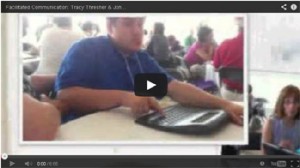
Facilitated Communication: Tracy Thresher & John Smyth at 2011 ICI Summer Institute
Supported typers Tracy Thresher, co-star of the documentary Wretches & Jabberers, and John Smyth use supported typing to have a conversation at Syracuse University’s 2011 Institute of Communication and Inclusion Summer Institute: Connection, Communication, and Creativity. A true example of Facilitated Communication in action! This is the first time Tracy and John had an opportunity…
More
Todd Washburne: Joining the Real World as an Adult Typer
I was raised as being retarded because I could not communicate. My frustration level was off the charts throughout my school years. The many times I got in trouble were driving me crazy and I couldn’t even be a tattletale so I was teased a lot. However, I did learn stuff like speed reading and…
More
Autistic Typer’s Poetry Reviewed by Bestselling Author Don Mann
John Smyth is a nonverbal autistic who, until recently, had no ability to communicate with anyone – parents, doctors, educators, siblings. As with many similarly afflicted individuals, John, a highly intelligent young man, was diagnosed as having a 3 year old’s mind and warehoused by his local school system in “life-skills” training until he was…
More
The Ember, a poem by John Smyth
The Ember by John Smyth When all I could lamely autistically do was open my mouth and make sounds that made no sense and behave in ways that were inconsistent with what a normal person would think or do, my autism looked as if it was what defined me and was all I might ever…
More
The Path to Independence: Introduction to Facilitated Communication
A journey of a thousand miles begins with a single step.Lao Tzu, 6th Century B.C. For thousands of children and adults on the Autism Disorder Spectrum (ADS), the ability to talk or communicate has been disrupted, or virtually eliminated in many cases, by the neurological disorder that affects 1 in every 88 children in the…
More
Starting Down the Path to Independent Typing
“I believe we cannot isolate physical independence from the other two elements of facilitated communication – communication and emotional support. Although I am called an independent typer because I no longer need physical touch, I cannot walk into a room, and type without a facilitator. The facilitator must still provide communication and emotional support to…
More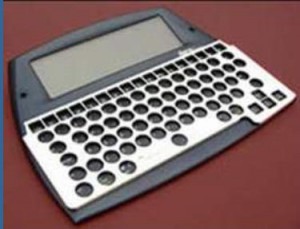
The Path to Independence: Step 1 – Facilitator Training
"(Facilitated Communication is) …strongest therapy for people with no means of expression is sensational, controversial, revolutionary, technically subtle FC. It involves understanding movement lapses of people and providing physical support to help overcome them. Plastic nature of users of FC requires topnotch weaning of support towards ultimate goal of independence." Larry Bissonnette, Independent Typer Facilitated…
More
The Path to Independence: Step 2 – Presumption of Competence
It is especially important that difficulties with communication not be taken as evidence of intellectual competence, as is often the case. It is easy for school administrators and teachers to make a blanket assumption that non-verbal autistics are mentally disabled as well as physically. The fight to overcome those assumptions is one of the most…
More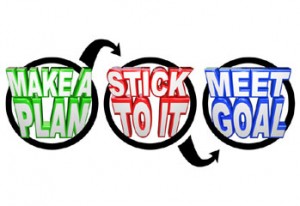
The Path to Independence: Step 3 – Create & Implement an FC Training Plan
The key to successful Facilitated Communication (FC) training is to create and implement a well-constructed training plan: FC user and facilitator agree upon steps towards independence: When will we practice? What activities will we use? How often will we reevaluate our plan? Establish at least 1 independent method of communication Yes/no ABCD…
More
The Path to Independence: Step 4 – Documentation of Facilitated Communication Progress
As Facilitated Communication (FC) training continues, it is important for the support team (FC trainers, family members, teachers, etc.) to know how far down the Path to Independence the FC user has come. Specific guidelines and standards are needed to support the ongoing use of FC. Evaluation of a person’s progress with FC can be…
More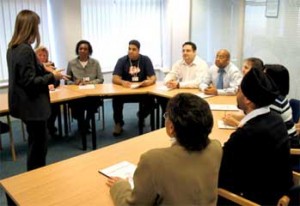
The Path to Independence: Step 5 – Training the Trainer
As the Facilitated Communication (FC) typer continues down the Path to Independence and their skills improve and advance, the facilitator/trainer should also continue to develop and improve their training techniques. The best way for them to do this is to set the goal of becoming a certified Master Trainer. Facilitated Communication Training (FCT) is a…
More
Hope Technology School – A Fully Inclusive Education for All Students
The private non-profit Hope Technology School (HTS) offers a WASC accredited K-8 school program, a licensed Preschool Program, as well as an NPA certified Therapy Department and Vocational Education Program. Located in Palo Alto, CA, HTS has been serving Bay Area families since 2001, with a mission to provide a fully inclusive education for both…
MoreThis is an example page. It's different from a blog post because it will stay in one place and will show up in your site navigation (in most themes). Most people start with an About page that introduces them to potential site visitors. It might say something like this:
Hi there! I'm a bike messenger by day, aspiring actor by night, and this is my blog. I live in Los Angeles, have a great dog named Jack, and I like piña coladas. (And gettin' caught in the rain.)
...or something like this:
The XYZ Doohickey Company was founded in 1971, and has been providing quality doohickeys to the public ever since. Located in Gotham City, XYZ employs over 2,000 people and does all kinds of awesome things for the Gotham community.
As a new WordPress user, you should go to your dashboard to delete this page and create new pages for your content. Have fun!